Safe Repositioning and Pressure Injury Prevention
The two-hour turning rule, how to move a patient without injuring yourself, the surfaces that matter and the early signs of a pressure ulcer.
Pressure injuries are largely a mechanical problem. A patient who is moved regularly, on a surface that redistributes load and supported by a mattress that keeps moving, does not develop ulcers.
The risk is highest on bony prominences: the heels, sacrum, shoulder blades and the back of the head. Skin that is thin, numb or poorly perfused is far less able to tolerate pressure.
This is a practical routine for families caring for a bed-bound patient.
The turning schedule
The standard advice is to reposition every two hours, and more often if the patient cannot hold a position or if the skin is at risk. Follow the schedule your nurse has given you rather than a generic one.
Always change the position, not just the direction. A patient who is turned from the left back to the left is not being turned.
Log the turns. A written schedule removes the memory load on the caregiver and gives the doctor a real picture.
How to move a patient safely
Raise the bed to a working height before you start. A bed at the lowest setting means you are lifting from your back.
Never pull the patient by the arms or under the armpits. Support the shoulders and the hips, and move them as one unit.
Use a slide sheet or a transfer board for a heavier patient. Two people are safer than one for a patient who cannot assist at all.
Lock the castors. A bed that can roll while you are lifting is the most common cause of a caregiver back injury.
The surfaces that matter
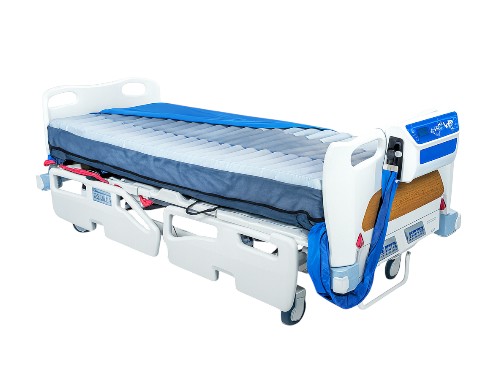
A foam mattress alone is not enough for a patient who will be in bed for more than a few days. Add an alternating-pressure air mattress overlay, which is exactly what it is designed to do.
Protect the heels. They are the most common site of pressure ulcers in bed-bound patients, and they take the least attention because they are under the bedclothes.
Keep the bedclothes smooth and dry, and avoid layers of bedding that create folds and pressure points.
Early signs of a pressure ulcer
Stage one is a defined area of reddened skin that does not blanch when pressed, and that stays red for more than thirty minutes after the pressure is removed. It is reversible.
Stage two is a partial-thickness loss of skin - a blister, a shallow open area or a shallow crater.
Anything beyond that needs a wound care professional. Do not dress it at home with a generic ointment and hope.
The single most important action is to relieve the pressure immediately and keep doing it, while you arrange for someone to look at it.
Nutrition and skin care
Pressure injuries heal faster when the patient is eating enough protein. This is one area where a dietitian and a doctor should be involved rather than a home remedy.
Keep skin clean and dry, moisturise dry skin, and do not use massage on an area that is already red or broken.
Check the skin daily, including the back of the heels, the sacrum and the skin folds. Early detection is the whole point.
Frequently asked questions
Every two hours as the standard, and more often if the skin is at risk or the patient cannot hold a position. Follow the schedule your nurse has given you.
For a patient who will be bed-bound for more than a week or two, yes. The bed provides function and the air mattress overlay provides pressure redistribution. The overlay is available on rent from ₹9,100 per month.
Need help choosing equipment?
Our team can help you select the right machine based on your doctor’s advice, the patient condition and the rental duration. Call +91 92242 82405 and we will talk it through.