Feeding Tube Nutrition at Home: Pumps, Rates and Troubleshooting
How a feeding pump delivers enteral nutrition safely, what rate to start at, how to handle a blocked line and how to clean the system.
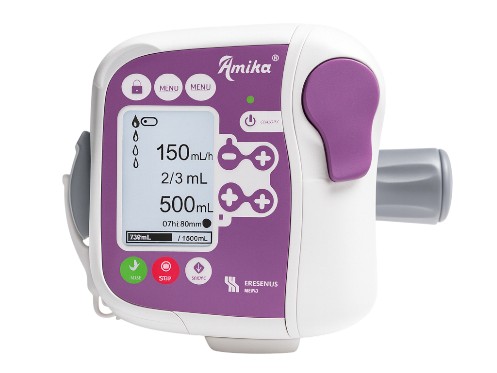
A patient who cannot swallow safely can still be fed properly. A feeding pump delivers nutrition through a nasogastric or PEG tube at a controlled rate, which is safer and more accurate than bolus feeds by hand.
The pump is simple to operate once it is set up. Almost every problem a family meets with it is one of four things: a blocked line, a trapped air bubble, a wrong rate, or a battery that has not been charged.
This guide covers each of them.
What a feeding pump does
The pump moves nutrition from a hanging bag through a sterile giving set and into the feeding tube at a set rate in millilitres per hour. Volumetric pumps deliver an accurate volume regardless of the fluid thickness.
Continuous mode runs at a steady rate over many hours. Bolus mode delivers a set volume over a shorter period, usually as prescribed after a feed intolerance check.
Modern pumps have a 24-hour internal battery, so a power cut does not interrupt a feed.
Starting a feed safely
Confirm the tube position before every feed start if the tube has been moved or the patient has been retching. Follow the checking procedure your nurse taught you; do not rely on a habit.
Prime the giving set before connecting, and close the clamp between the bag and the patient when the feed is not running.
Start at the rate on the prescription and increase only as the care plan allows. A sudden increase is the most common cause of diarrhoea and bloating.
Flush the line with water before and after the feed as prescribed, and record the flush volume.
Troubleshooting a blocked line
Do not force anything. Never push a syringe hard against a resistance, and never use a fizzy drink or juice to clear a line.
Check the simplest causes first: is the clamp open, is the roller clamp fully open, is the bag empty, is the tube kinked under the patient.
Try a gentle warm water flush with the prescribed syringe size. If it still will not clear, stop and call us - we will replace the set and check the pump.
Never use a wire or a sharp object to clear a giving set.
Air in the line
A large air bubble in the line can cause discomfort and, if it reaches the stomach in volume, bloating and pain. Most units detect it with a downstream sensor.
Close the clamp, disconnect the set from the patient, and let the air clear through the drip chamber before reconnecting. Never force air towards the patient.
If the pump keeps alarming, the set may need replacing - a micro-air bubble that keeps entering the bag is usually a cracked spike or a bag that is not seated properly.
Cleaning and the daily routine
The giving set is a single-use item. Replace it every 24 hours for continuous feeds, and immediately if it becomes contaminated or the tubing is discoloured.
The bag is also replaced daily. Wash the pump exterior with a damp cloth, and never pour liquid into the pump.
The pump itself is serviced by us as part of the rental. The consumables - giving sets, bags, syringes - are supplied and replaced at cost.
Frequently asked questions
Up to 24 hours of continuous operation on most units. We recommend an inverter for uninterrupted overnight feeding and check the battery before every handover.
Read the alarm first - occlusion, downstream resistance, door open or low battery. Never lower the alarm threshold to silence it. Call +91 92242 82405 and we will guide you through the check.
Need help choosing equipment?
Our team can help you select the right machine based on your doctor’s advice, the patient condition and the rental duration. Call +91 92242 82405 and we will talk it through.