Choosing a Patient Monitor for Home Care
Three parameter versus five parameter monitors, which vitals matter after which surgery, how to set alarm limits and how to share readings with your doctor.
A patient monitor is the cheapest way to turn a home bedroom into an observation unit. It tracks vitals continuously and raises an alarm when a value crosses a limit you set.
The most common mistake is buying more monitoring than the patient needs. Five parameters on a patient who only needs saturation and blood pressure adds alarm fatigue, which is when real alarms get ignored.
Here is how to choose the smallest monitor that answers the question your doctor actually asked.
What each parameter means
Heart rate is the simplest and most reliable. Blood pressure is the most useful after cardiac events. Oxygen saturation is the one families worry about most, and it is also the one most affected by a cold hand or a loose probe.
Respiratory rate is the early warning sign in many deteriorations. ECG gives rhythm, which matters after a cardiac event or on medications that affect conduction.
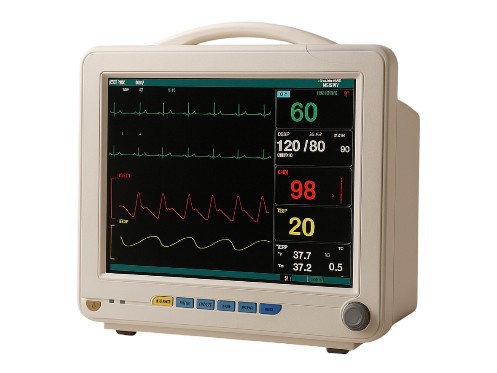
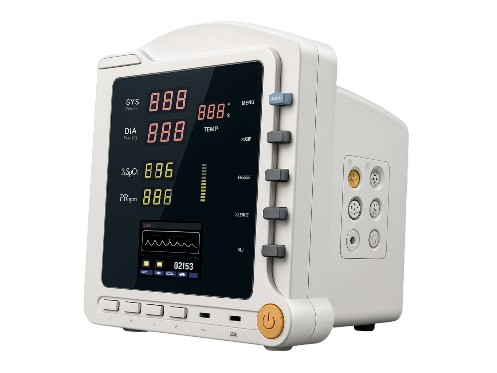
A three parameter monitor gives heart rate, non-invasive blood pressure and saturation. A five parameter unit adds respiratory rate and ECG, plus often temperature.
Which one for which patient
After general surgery, a three parameter monitor is usually enough. The nursing staff on the ward will tell you what they were watching.
After a cardiac event - an angioplasty, a bypass, a heart failure admission - ask for ECG and respiratory rate. The five parameter monitor at ₹5,850 per month is the right unit.
For a patient on home oxygen, saturation trending matters more than the ECG. The three parameter monitor at ₹4,100 per month with a good probe will do the job.
Setting alarm limits
Set the limits from your discharge summary, not from a general manual. If the ward set a saturation alarm at 88%, keep it at 88% at home.
Set the limits so that a real deterioration wakes the caregiver and a minor fluctuation does not. Too tight a limit trains a family to ignore alarms.
Write the alarm limits on a card taped to the monitor and next to the bed. At 3 AM, nobody should have to remember a number.
Reading a false alarm
The most common false low saturation is a cold, poorly perfused hand. Warm the hand, reposition the probe on the finger, not the toe, and wait a minute.
Check that the probe is the correct type for the patient, and that the cable is not stretched or kinked at the machine end.
If the ECG trace is noisy, check the electrode contact and the limb cable. Persistent noise usually means a loose reference electrode.
Your doctor interprets the readings. We can help you understand the equipment, but the clinical meaning belongs to the treating physician.
Power, batteries and data
Every monitor we rent has an internal battery that keeps the display and alarms running for a couple of hours. For overnight monitoring, use an inverter.
The units store trends for 24 to 48 hours depending on the model. Photograph the screen at set times, or at each nurse visit, so your doctor can see the pattern rather than one number.
Sensors are consumables. A probe that has been on a patient for weeks can drift, and the readings become less trustworthy before the unit tells you anything.
Frequently asked questions
Usually not. Ask the discharging team what they were monitoring. Three parameters cover most general surgical recovery; ECG and respiratory rate matter mainly after a cardiac event.
Follow the schedule on your discharge summary. If none was given, a reasonable routine is every four hours overnight and every two hours if the patient is unwell or newly weaned off oxygen.
Photograph the display or export the trend view. Your doctor can interpret that directly. You can also call our 24/7 helpline for help with the equipment itself.
Need help choosing equipment?
Our team can help you select the right machine based on your doctor’s advice, the patient condition and the rental duration. Call +91 92242 82405 and we will talk it through.