COPD Home Oxygen: What Long-Term Therapy Involves
How long-term oxygen therapy works for COPD, why the flow rate is non-negotiable, how to tell if it is working and the questions to ask your pulmonologist.
Chronic obstructive pulmonary disease reduces the ability to move air. For a subset of patients with persistently low oxygen levels, long-term oxygen therapy is not a comfort measure - it is a treatment that changes survival.
It also has to be used correctly. Too little oxygen does not help, and in some patients with chronic carbon dioxide retention, too much can suppress the drive to breathe.
This is a practical guide to what home oxygen therapy for COPD involves day to day.
When oxygen is prescribed
Long-term oxygen therapy is usually considered when saturation stays below 88% or PaO2 below 55 mmHg at rest, or when there is evidence of pulmonary hypertension, oedema or polycythaemia.
The prescription specifies the flow rate and the number of hours per day. Fifteen hours a day is the usual minimum for a meaningful outcome, and many patients use it for longer.
A single good reading in the clinic is not enough. Doctors usually want to see a stable low reading over a period before committing to a machine.
Why the flow rate is non-negotiable
Too little oxygen leaves the patient hypoxaemic and does nothing for the complications. Too much can raise carbon dioxide in a patient who retains it, which is why patients with COPD are monitored on a controlled oxygen delivery device rather than uncontrolled high-flow oxygen.
Never increase the flow on your own. If you feel the patient needs more, call the doctor and report the saturations.
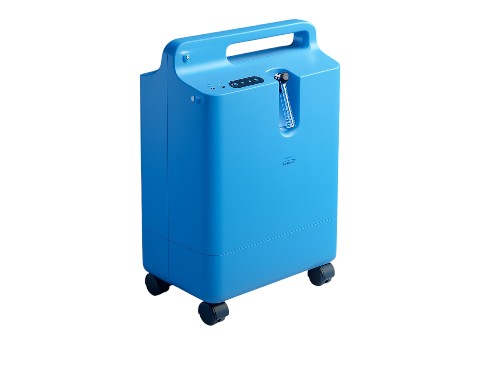
If the prescription is for a 2 LPM and the machine is a 5 LPM unit, that is completely normal. The unit supplies up to 5 LPM; the flow knob sets what the patient actually receives.
How to tell it is working
The early signs are practical: less breathlessness climbing stairs, clearer thinking, better appetite and fewer morning headaches.
Keep a simple diary of saturations taken at the same times each day, for example morning, mid-afternoon and night. A trend is far more useful than a single number.
A slight increase in sputum volume in the first days can happen as the airway opens. A significant increase with fever or chest pain needs a doctor.
The practicalities of living with a concentrator
The machine is loud enough to sit in another room, and the cannula tubing can be extended to 10 to 15 metres. Most families run the machine in the bedroom or the hall with the tube passing along the wall.
Power is the real constraint for overnight use. A 1 KVA inverter with a stabiliser is adequate for a 5 LPM unit; a 10 LPM unit needs more, and a ventilator alongside it needs considerably more.
Keep a full cylinder as a backup and know how long it runs at the prescribed flow.
Cost and access
Renting a 5 LPM concentrator starts at ₹3,250 per month and a 10 LPM unit at ₹7,850 per month, including delivery, installation, family training and servicing.
Portable units are available to buy for patients who travel, from ₹1,44,849 for the Oxy-Med.
If the cost is a barrier, say so on the call. We will always present the cheapest option that meets the prescription rather than the most expensive one that works.
Frequently asked questions
Most COPD prescriptions are for at least 15 hours a day, and often longer. Use it as prescribed rather than only when the patient feels short of breath.
Yes, and it is usually prescribed that way. Run the machine in a well-ventilated room with the tubing routed along the wall, and use an inverter for overnight use.
Need help choosing equipment?
Our team can help you select the right machine based on your doctor’s advice, the patient condition and the rental duration. Call +91 92242 82405 and we will talk it through.